Living Lab Deep Dives: Exploring Nature-based Solutions in Aarhus, Poznań and Cascais
September 2, 2026 | News
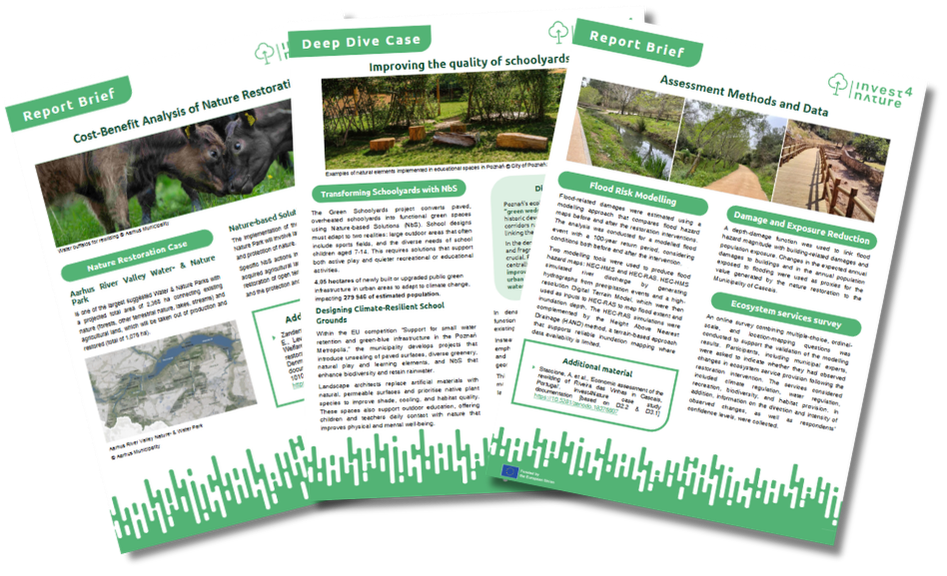
How can nature-based solutions create measurable benefits for communities, ecosystems and local economies? Three Invest4Nature Living Lab Deep Dive briefs provide a closer look at real-world NbS cases in Denmark, Poland and Portugal.
Designed as short, accessible and visual summaries, the briefs highlight key findings from Invest4Nature’s Living Labs and demonstrate how nature-based solutions can address local challenges while delivering multiple environmental and societal benefits.
Aarhus Living Lab: welfare economic assessment of large-scale nature restoration
The Aarhus Living Lab Deep Dive explores a large-scale nature restoration plan in Denmark, where 11 Water & Nature Parks are planned to more than double existing nature areas. Focusing on the Aarhus River Valley Water & Nature Park, the brief presents the results of a social cost-benefit analysis covering water quality improvements, groundwater protection, recreation, carbon sequestration and project costs. The findings show that every euro invested generates 4,15€ in benefits for society.
Poznań Living Lab: creating a climate-resilient city by greening educational spaces
The Poznań Living Lab Deep Dive highlights the Green Schoolyards initiative, a multi-annual investment aimed at transforming educational spaces. The project improves local microclimates, enhances rainwater retention, supports urban biodiversity and creates greener recreational areas for students. The case illustrates how nature-based solutions can make cities more resilient while improving everyday environments for children and communities.
Cascais Living Lab: rewilding of the Ribeira Das Vinhas
The Cascais Living Lab Deep Dive examines nature restoration measures in the Ribeira das Vinhas catchment area. Using flood damage modelling, the study assessed the economic value of these interventions and found that they reduced the number of people displaced by flooding by 60% and lowered flood-related damages by 43%. An accompanying expert survey also identified positive effects across all assessed ecosystem services, particularly recreational value and ecological quality.